In this video
- Unity's rules, from Unity's own docs: a single inlined, minified HTML file, under 5 MB
- MRAID 3.0 (Unity's web view injects it), portrait and landscape, and the CTA through mraid.open — never an automatic redirect
- No network requests, never block the close button, and wait for the viewableChange event before starting
- Build: remix a template, tick Unity in the Export window, paste your App Store and Google Play links
- Test: the free spec checker in your browser, then Unity's Ad Testing app on iOS and Android
- Upload: Creative Packs → Create → Playable, then assign the pack to your campaigns
- Using a video? Unity also takes a Video & Playable end card pack, with a responsive playable after the video
About this video
A playable ad on the Unity Ads network is a short interactive demo, delivered as one HTML file that runs inside Unity's ad player. Unity's specifications ask for a single inlined, minified file under 5 MB that follows MRAID 3.0, supports portrait and landscape, needs no network requests, and sends people to the store through mraid.open only after they tap. In this tutorial a prebuilt template is exported for Unity with no code: tick Unity in the Export window, add your store links and export. The file is checked with the free spec checker, which runs in your browser, and Unity's Ad Testing app previews it on a phone. It is then uploaded as a Playable creative pack, and Unity reviews every new creative before it goes live.
Exports for Unity, AppLovin, Google, IronSource, Mintegral, Meta (Facebook), Moloco, TikTok, Liftoff, Vungle, Chartboost, InMobi and Pangle — one self-contained HTML5 file each.
Free Playable Ad Spec Checker →Unity's playable asset specifications →Unity: preview with the Ad Testing app →Unity: add a playable creative →
Transcript
Captions in 18 languages on YouTube
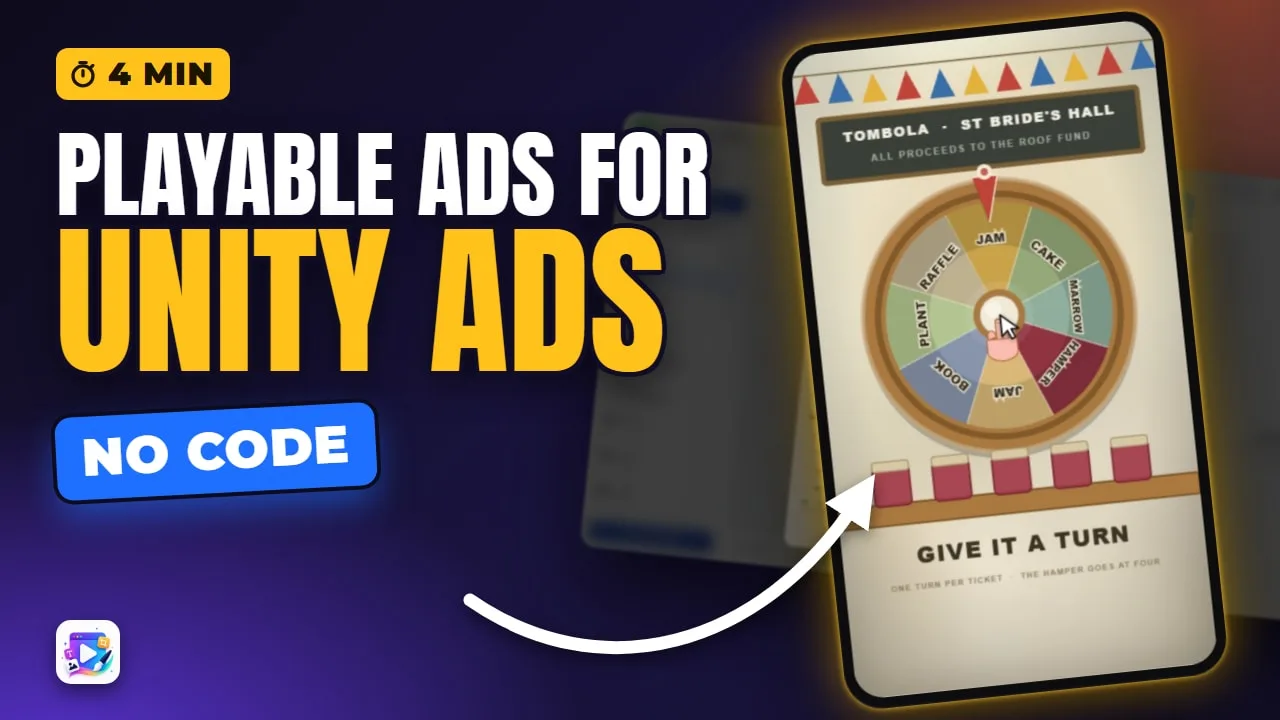
This spin-the-wheel ad is built for the Unity Ads network, and I made it with no code. Give it a turn.
In the next few minutes: what Unity requires of a playable ad, how to build one that meets it, how to test it, and how to upload it.
And the button sends people to the store only when they tap it.
Read the full transcriptShow less
First, the rules. Everything here comes from Unity's own playable ad specifications, and the links are in the description.
One: the whole ad is a single HTML file, inlined and minified, with no links to other files or folders.
Two: it has to be under 5 MB.
Three: it follows MRAID 3.0, the standard an ad uses to talk to the app it runs in. Unity's web view injects it for you.
Four: it should support both portrait and landscape.
Five: the call to action opens the store through mraid.open, and never by itself. No redirect without a tap.
Six: it shouldn't need any network requests. Analytics calls may be allowed, if they carry no personal data. And it must never block the close button.
Seven: it should wait for MRAID's viewableChange event before the game starts, so it only begins once it's really on screen.
Now let's build one. Open the Spin the Wheel template, and press Remix this template.
It already has a portrait and a landscape layout, so both orientations are covered.
Press Export, and tick Unity. The URL badge means Unity opens the store link your ad supplies, through mraid.open.
The estimate is under 1.5 MB, far inside Unity's 5 MB.
Paste your App Store and Google Play links. That's where the button will send people.
Keep Web Preview on. It adds a copy that plays in any browser, and it never uses an export.
Then Export. On the real site you sign in first, and a network export counts as one of your plan's monthly exports.
You get a zip with two files: the Unity file to upload, and the web copy.
Before uploading, test it. Our free spec checker reads the file right in your browser, and nothing is uploaded.
Choose the Unity file, and pick Unity Ads. It passes: under the size limit, a single HTML file, the mraid.js tag in place, and the button wired to mraid.open.
A pass means nothing disqualifying shows in the file. It isn't Unity's approval.
Here's the Unity file itself, at phone size. Tap, spin, and the End Card.
And the very same file, turned sideways.
Then test it where it will run, with Unity's Ad Testing app for iPhone and Android. It needs the file at a web address ending in .html, and https for iPhone. Upload it to the Unity dashboard or host it yourself, then scan its QR code.
Play it several times, and make sure it loads, plays and runs smoothly every time.
To upload, open Creative Packs in your Unity Ads User Acquisition dashboard. Choose Create, then Playable, and name the pack.
Pick the playable type, upload the file or add it by URL, choose its language, and press Create.
Then assign the pack to your campaigns. Every new creative goes through Unity's human review, and a campaign needs an approved pack to go live.
To try it yourself, remix the Spin the Wheel template. The link is below. Next up: the same checklist for AppLovin. See you in the next video!
Build your first one free, at playableadsmaker.com.