In this video
- An event is a rule: a trigger on an object, and the actions it runs
- Triggers: Tap, Double Tap, Hold, Dropped On and Follow the Path — plus Timer End, At Second, Animation Complete and Burst Complete
- Actions and their targets: Swap Image, Set Text, Move To and Show / Hide Object
- The orange "Nothing will happen" warning, and what it means
- An End Card in a few clicks, opened with a Hold and a progress ring
- Portrait, landscape and languages: the two things to check
- Testing every tap and hold with Play
- Three mistakes to avoid: two navigations in one trigger, objects hidden at the start, a CTA Button next to an End Card
About this video
Events are what make a playable ad playable. Every object can listen for a trigger — a tap, a double tap, a hold, a drop onto another object, or a drag along a path — and run a list of actions when it happens: swap an image, change a line of text, slide something in, show or hide something, or move to the next scene. In this tutorial the whole ad is built from a blank project, so its events can be edited on every plan; the events of a prebuilt template are editable on the Agency plan. Everything shown here fires the same way in the editor preview and in the exported HTML5 file for every ad network. The next tutorial adds Variables, so the ad can remember what people chose.
Exports for Unity, AppLovin, Google, IronSource, Mintegral, Meta (Facebook), Moloco, TikTok, Liftoff, Vungle, Chartboost, InMobi and Pangle — one self-contained HTML5 file each.
Transcript
Captions in 18 languages on YouTube
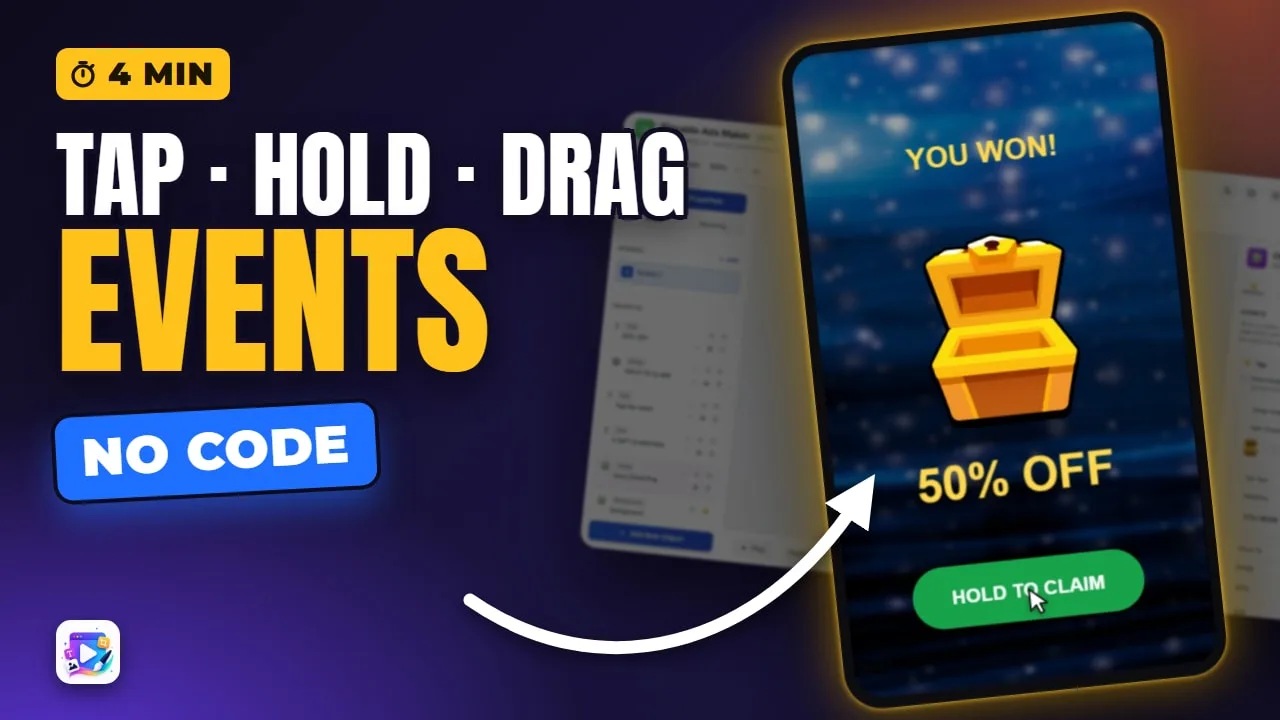
Tap the chest, and four things happen at once: it opens, the headline changes, a badge slides in, and the hint disappears. Hold the button, and the End Card opens.
Those are events. In the next few minutes, you'll build every one of them, with no code.
An event is a rule: when something happens to an object, do these things. The something is the trigger. The things are the actions.
Read the full transcriptShow less
I started this project from scratch, so I can edit its events on any plan. Editing the events of a prebuilt template needs the Agency plan.
On the canvas there's a chest, a headline, a hint and a button. And a badge is waiting just off the right edge.
Select the chest, open the Events tab, and pick a trigger. I'll choose Tap.
That adds a rule. Every action inside it runs each time the chest is tapped.
First action: Swap Image. Its target is Self, the chest itself, so I only choose the new picture: the open chest.
Next, Set Text. See the orange warning? Nothing happens until every field is filled in. That's the first thing to check when an event seems dead.
I'll point it at the headline, and type the new words.
Move To slides the badge in. Pick the badge, then type where it should land. Half a second, easing out, is just right.
Last, Show / Hide Object. Target the hint, and choose Hide.
Every object has the same triggers: Tap, Double Tap, Hold, Dropped On, for dropping it onto something, and Follow the Path, for swipes and drags along a route.
Some objects bring their own. A timer fires Timer End or At Second, an animated sprite fires Animation Complete, and particles fire Burst Complete.
Now the finish. Add New Object, Add End Card, and pick a design. That's the screen that sends people to the store.
Back on Scene 1, select the button and add a Hold. Tick Progress ring, so people can see the hold filling up.
Its action is Go to Scene, and the scene is the End Card.
Events work the same in portrait and landscape, with two things to check. Move To has one position for both orientations, so preview landscape too. And once your ad has more than one language, Set Text gives you a box for each, so translate the new words too.
Now press Play, and try it. Tap the chest.
Then hold the button. The ring fills up, and there's the End Card.
Three mistakes to avoid. One: a trigger can only navigate once. After Go to Scene, a second navigation is marked already used.
Two: an object you hide with the eye icon is never created in the ad, so Show / Hide can't bring it back. Leave it visible, and use Show If Variable instead. That's the next video.
Three: every button on an End Card already opens the store, so you don't need a CTA Button there. A CTA Button is for ads with no End Card at all.
For a finished example, remix the Open the Crate template. Its taps are already wired, so you only swap in your own art and words. Next up: Variables, so your ad remembers every choice. See you in the next video!
Build your first one free, at playableadsmaker.com.